

Whether you are the person asking the questions or the person in the ‘hot seat’, answering, your voice is crucial to the success of an interview.
Remember to set aside time to warm up your voice before your interview. If your voice is relaxed and flexible, your vocal folds prepared, all will respond more readily to conveying your tone and emotional content. This will affect how your listeners feel about you and your content.
Warming up your articulators is also important. Get your lips moving beforehand, get your tongue ready to spring into action to shape your words clearly and your words will be clear and easily understood.
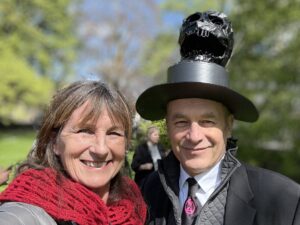
During the radio interview I conducted with Chris Packham recently, I noticed how easily he switched into media mode. His voice was charismatic, he moved seamlessly from topic to topic and his voice was well supported.
Essential preparation for media interviews is a thorough knowledge of your subject and Chris Packham spoke fluently about the catastrophic decline in insect numbers in the UK over the past 20 years and the loss of 97% of wildflower meadows in the past 40 years. This ecologist and BBC presenter also gave words of encouragement to individuals who are making a different to their environment through building a garden pond, planting trees, allowing wildflowers to grow prolifically to support the natural environment.
Part of the interviewing process is using your listening skills, as well as speaking skills. When you are being interviewed, it is vital to listen to your interviewer to assess what they are asking and how you wish to answer. Sometimes words might elude you, or your mind might go blank during an interview. Take time to breath, let your thoughts come back to you. In a pre-recorded interview the editor can easily take out speech mistakes.
Practise speaking aloud as much as you can if being interviewed is part of your job or voluntary role. Record yourself, listen back and identify words or phrases that might be repeated too much. Look out for hesitation sounds, too, like ‘um’ or ‘er’; repeat the recording exercise and avoid repeating these sounds.
Finally, think about who is listening to you. Address your audience in the right tone, with the right choice of words. Speaking to a BBC Radio Four business audience may dictate a different tone and sentence structure from a Local Radio community audience. Making the right choice with your tone and words can make a huge difference to the success of your messaging.
- Swot up on your topic.
- Practise speaking aloud and recording yourself, eliminating repeat- or pause-words.
- Warm up your voice.
- Warm up your articulators.
- Speak to your audience.
A professional voice coach can help you to prepare your interview with the media or with a panel. Rehearsals, familiarity and practise can make an ocean of difference to the success of your interview.
For more information about training for broadcasting or interviewing, please get in touch to arrange an informal, free consultation.